
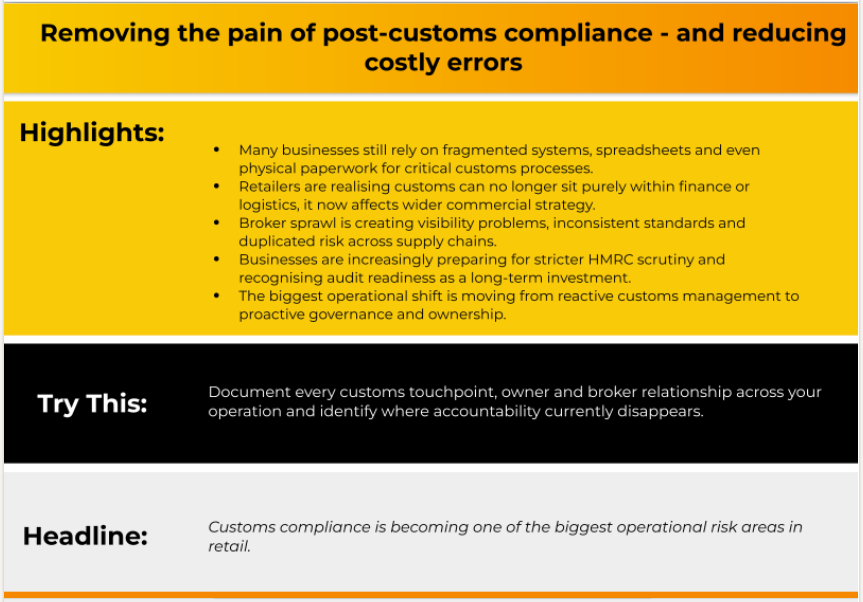
“Customs compliance is becoming one of the biggest operational risk areas in retail.” That was one of the recurring themes during The Retail Hive’s Supply Chain Leaders Exchange in May 2026.
A few years ago, customs discussions often stayed within specialist teams. Today, retailers are increasingly discussing visibility, audit readiness, fragmented processes, broker management and operational ownership.
That shift matters.
Customs no longer sits quietly in the background as an isolated operational process. It increasingly affects commercial strategy, financial exposure and operational resilience across the wider business.
Why the conversation is changing
This is not really about customs suddenly becoming more complex overnight. The bigger change is that supply chains have become more interconnected, regulatory expectations have increased and businesses are under greater pressure to demonstrate control across international trade operations.
Retailers are dealing with:
- Changing tariffs and trade measures
- Increasing regulatory scrutiny
- More fragmented supply chains
- Growing expectations around governance and audit readiness
- Greater pressure to create visibility across operational data
At the same time, customs data is often still spread across brokers, spreadsheets, emails, PDFs and disconnected systems. Fragmented structures become increasingly difficult to oversee, explain internally and verify afterwards.

Visibility is becoming business critical
One of the strongest recurring themes during the event was visibility.
Many businesses still struggle to answer relatively straightforward operational questions quickly and consistently:
- What was actually declared?
- Which broker submitted the declaration?
- Which supporting documents exist?
- How consistent are the processes across providers and countries?
- Where does accountability sit internally?
These questions become particularly important during audits, internal reviews or investigations into errors and underpayments. By that stage, businesses often discover how fragmented the underlying processes and data structures have become over time.
Audit readiness is therefore becoming less of a one-off exercise and more of an ongoing operational capability.
Mark's Memo: What happens when you actually start checking your customs data
Customs is moving beyond the specialist teams
Another noticeable shift is how many different functions are now affected by customs related decisions.
Finance teams care about duty exposure and underpayments. Procurement teams are affected by sourcing changes and origin requirements. Sustainability and compliance teams increasingly work with trade related reporting obligations. Leadership teams want clearer visibility into operational and regulatory risk.
At the same time, customs processes and terminology can still be difficult to explain outside specialist environments. That creates an important challenge for many organisations: How to make customs compliance understandable and actionable across the wider business.
Fragmented setups create operational risk
Many retailers work with multiple customs brokers for perfectly valid operational reasons. Different markets, transport flows and business models often require different operational setups.
However, fragmented structures can also create long term challenges around consistency, visibility and control.
Different brokers may apply different processes. Supporting documentation may sit across multiple systems. Data structures vary. Local practices evolve independently. And when businesses later attempt to create a consolidated view across customs activity, the process often becomes far more difficult than expected.
The issue is rarely one isolated declaration. The bigger challenge is usually the lack of a clear operational overview across the full customs landscape.
Carsten's Corner: Customs data is infrastructure
The operational reality behind customs compliance
One of the most interesting aspects of the discussions during The Retail Hive’s Supply Chain Leaders Exchange was how operational they were. Participants spoke openly about where complexity builds up, where accountability becomes unclear and how difficult it can be to create visibility across fragmented customs processes and data.
The conversations focused less on theory and more on the practical reality businesses are dealing with every day. That is also why the phrase “operational risk” resonated with many people in the room.

Building better visibility across customs operations
Many retailers are now looking more closely at how they structure, access and work with customs data across the business. That includes everything from broker management and internal audit processes to historical declaration access, supporting documentation and ongoing verification of customs transactions.
At Emma Systems, these are some of the challenges we work with through Emma Compliance: Helping businesses collect, structure and analyse customs declarations and supporting documents across brokers, countries and systems in one place.
Emma Compliance make customs data easier to access, analyse and work with across the wider organisation.
Ready to dig deeper?
Access our guide on Customs Data Analysis

More content is waiting for you!
Checklists, guides, customer stories and much more can be found in our Resource center
